
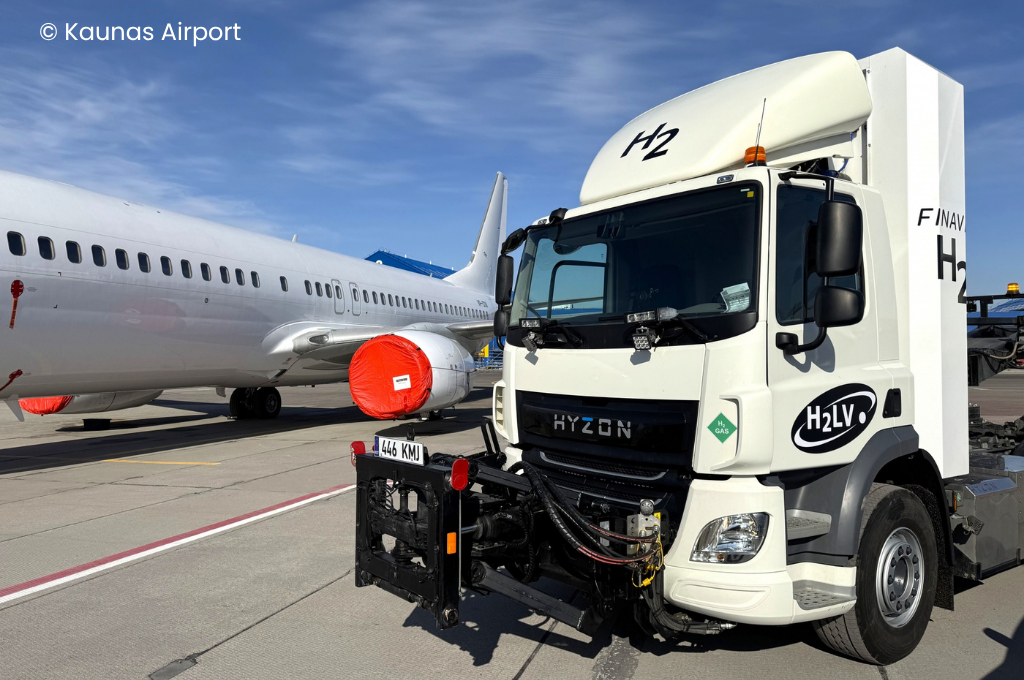
Kaunas Airport (KUN) has tested a hydrogen powered truck as part of a wider European initiative to accelerate the adoption of sustainable fuels in airport operations.
The trial forms part of an EU funded project focused on integrating hydrogen into ground handling and airside activities. Led by Lithuanian Airports, the programme is also being conducted at airports in Helsinki, Riga and Tallinn, reflecting growing regional collaboration on decarbonisation. The hydrogen powered vehicle, developed by Hyzon Motors, was tested across apron, runway and taxiway environments. The heavy duty truck completed operational tasks such as surface cleaning and maintenance without producing CO2 emissions, demonstrating its potential for deployment in day to day airport activities.
According to Modestas Alekna, Head of Sustainable Aviation Projects at Lithuanian Airports, ground transport plays a critical role in achieving wider sustainability goals.
“Green hydrogen is considered a fuel of the future,” he said. “Testing hydrogen powered transport provides valuable operational experience and supports our long term strategy for reducing emissions.”
Testing was carried out over several days, with the vehicle covering approximately 100 kilometres while performing routine airside tasks. Operational planning ensured that any potential disruption to airport activities was avoided, with designated testing zones selected across the airfield.
In addition to the Hyzon truck, a Toyota Mirai passenger vehicle was also trialled, highlighting the broader applicability of hydrogen technology across different vehicle types. Hydrogen supply and refuelling infrastructure for the project was provided by the Latvian Hydrogen Association, ensuring the use of fully renewable hydrogen produced through electrolysis using solar and wind energy.
The trials demonstrated reliable performance, with airport specialists reporting positive results across operational and environmental metrics.
Kaunas Airport was selected for the pilot due to its operational flexibility and lower traffic volumes, enabling controlled testing conditions.
The initiative supports Lithuanian Airports’ target to achieve carbon neutrality by 2030 and aligns with wider European Union ambitions to scale hydrogen as a key energy source for transport decarbonisation by 2050.
Find more information, available here.